
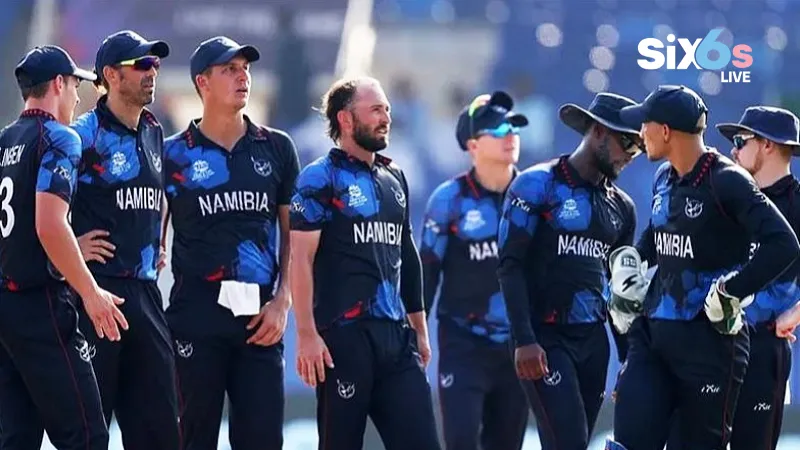
Namibia will arrive in India and Sri Lanka for the 2026 T20 Cricket World Cup as the underdog. No one expects to see them beyond the first round. The Namibian team consists of no superstars, and none of its members are old enough to remember the good old days. In fact, the average age of the team is likely less than 21 years. However, while it’s true that the young Namibians lack experience, they do have a clear plan. And that plan is to shake things up at the top of the game by using the combination of their fresh faces and strategic thinking to challenge cricket’s long-standing elite. When you combine audacity (a willingness to take risks) with fearlessness and thorough preparation, the odds typically favor the underdog. Namibia may be the next example of this trend.
Youthful Firepower Meets Tactical Guidance
Ben Shikongo (25) and Jack Brassell (20) make up a pacesetters’ combination whose youthfulness is tempered by experience. While Brassell has only played 9 ODI’s and 18 T20I’s, he is unafraid to take risks and embodies some of the same qualities as an underdog legend, such as Afghanistan’s Rashid Khan, who burst onto the international scene in 2017 with only a few games of experience. Shikongo, who starred for Namibia in qualifying matches against Tanzania, has the type of maturity that will allow Namibia to rely less on raw energy when using this pair. The two represent a carefully considered gamble; a bowling attack that can produce surprise wickets, while also being guided by the measured expertise of both players.
Debutants With a Point to Prove
By bringing in Max Heingo just after Namibia won its first T20I match, the squad is demonstrating that it is looking to utilize both newness and momentum as it continues on the path of development. The quicker you take out significant wickets in your very next match, as they are facing one of the greatest countries for cricket at this time, can significantly increase a player’s reputation and increase the confidence of his teammates. Younger players in the middle order, like Jan Balt, Dylan Leicher, and Willem Myburgh, will be able to play without concern because they have little experience internationally, which could give younger teams an advantage over older teams during a competition such as this, where younger teams’ nervousness may lead to them being less capable than older teams.
Experience in the Mix: The Erasmus Effect
Namibia has its unpredictable base of operations in the form of Zane Green and J.J. Smit (along with Gerhard Erasmus), which provides an anchor for the team’s base of operations. Leadership by Gerhard Erasmus is much more than simply a ceremonial role; it is a strategic role as well. Associate countries that historically had a strong backbone of captains, i.e., William Porterfield from Ireland and Kyle Coetzer from Scotland, were able to exceed expectations at times. It will be the responsibility of Erasmus to provide the team with a combination of motivational clarity and tactical sense that balances the wild, free-wheeling nature of his youth with solid game plans.
Kirsten’s Consultancy: Outsider Insight
The inclusion of Gary Kirsten undoubtedly represents the X-factor. As a mentor to talent such as AB de Villiers and as India’s coach in the 2011 World Cup, Kirsten can merge the technical aspect of cricket (technical skill) and the mental preparation that players need. Kirsten will be the eyes from outside that can see the minute difference that can swing a game, which is ideal for a young team that needs every run and every wicket to possibly win a game. The presence of Craig Williams provides additional experience and connects the dots between the youth and the experienced team members so that they are a cohesive group ready for big game pressure.
Stay updated on the latest cricket news and exciting updates at Six6slive. Dive into our in-depth articles and analyses to connect with the action today!