
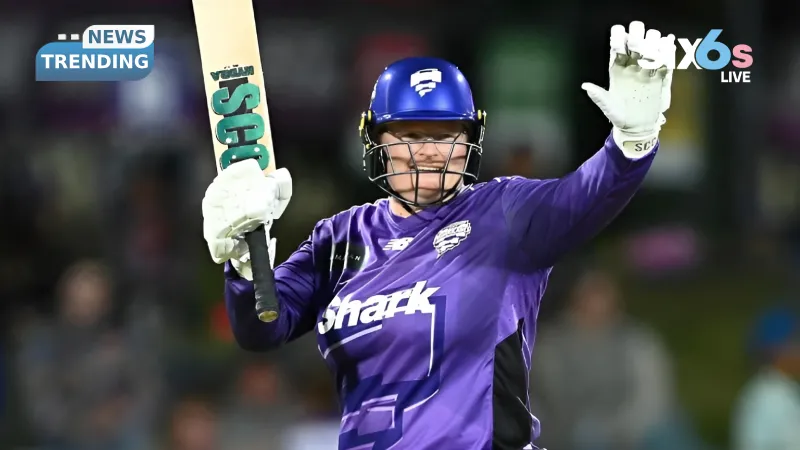
The finals are expected to be high-pressure, nervous, and slow-paced events; however, the WBBL final was an exception to that rule. Before some fans could even get comfortable in their seats, Lizelle Lee had completely derailed the typical expectations for a WBBL final. In pursuit of 138 runs for victory, the Hobart Hurricanes turned what is generally considered a chess match into a complete demolition of the opposing team’s strategy and ultimately sealed their first-ever WBBL title with an eight-wicket victory and five overs remaining.
When the Powerplay Became a Weapon
The run-chase was defined by the first two overs. In the first over, Lee hit three consecutive boundaries to cut the total required down to “manageable” to “minimal”. Danielle Wyatt-Hodge then repeated this feat in the second over. By the end of the second over with no wickets lost and 24 runs on the board, the Hurricanes weren’t simply chasing a score; they were building a lead.
The sixes were not reckless shots; they were calculated domination. The Scorchers needed an early couple of wickets to create some pressure so that they could be in a position to make a final push for victory. Instead, Lee kept the required run-rate at a walking pace. By the sixth over, when Wyatt-Hodge fell, the Scorchers’ chase had lost its momentum, and we all know how unforgiving finals can be once that happens.
Scorchers’ Fatigue and a Flat Powerplay
Having already been forced to carry her team in their previous matches (she had scores of 94*, 45 & 76), Beth Mooney was once again left trying to save the day. However, even her efforts couldn’t help as she fell to Heather Graham’s good bowling and was eventually bowled for 33 after numerous close calls. In short, the Scorchers had an awful first half hour and did nothing to start their innings, so it didn’t matter who batted next.
At the top level, finals require your best sharpness. Perth were marginally off it, and as we know, margins can be the difference between winning or losing a trophy.
Lee’s Six-Hitting That Ended the Contest Early
The middle overs sealed the outcome of the contest. The power play had set the tone for the game, but after a slight break, Lee took on Alana King with brutal accuracy, 2 back-to-back sixes, then two in the very next over. When she reached her half-century, it was not with excitement, but with absolute finality.
When Nat Sciver-Brunt scored at a run-a-ball rate of 35 to ensure that things stayed on track, the momentum had shifted decidedly in favor of the Hurricanes. Lee had demonstrated a superior ability to adjust her pace of play without hesitation or risk, showing an elite T20 level of batting intelligence. In addition to chasing down the total number of runs required to win the game, Lee removed all doubts about the eventual winner. By the time Sciver-Brunt was dismissed, the trophy was clearly going to go to the Hurricanes.
This WBBL Final was not won through marginal gains or a conservative approach; it was won with intent. Lizelle Lee showed that in today’s version of T20 Cricket, particularly in finals, controlled aggression is often the safest form of play. The Hobart Hurricanes did not sit back and allow Perth Scorchers to self-destruct; instead, they made them irrelevant.
The Scorchers’ tiredness and their cautious play at the beginning of the inning cost them a great deal. This was history made by the Hurricanes with an obvious reason of intent. The innings of Lee will be remembered as much for the runs he scored as for how his innings would challenge the traditional thought process that finals must always be played cautiously.
Stay updated on the latest cricket news and exciting updates at Six6slive. Dive into our in-depth articles and analyses to connect with the action today!