
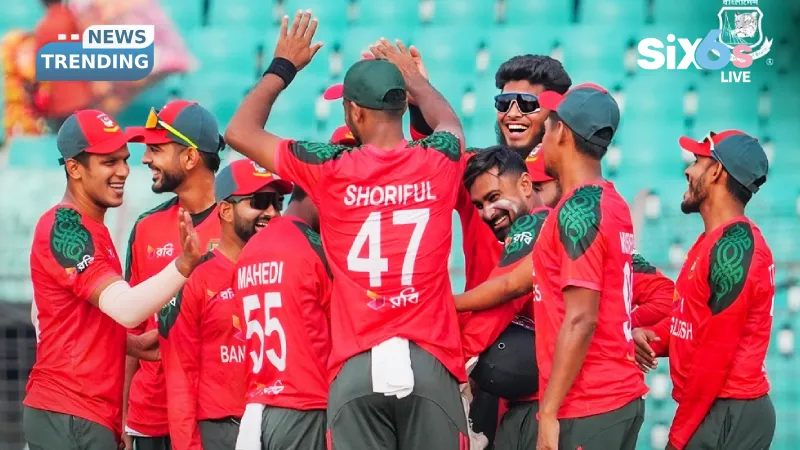
The Bangladesh captain Litton Das claimed his team was “almost ready” to compete at the T20 World Cup after they bounced back from their opening match loss to beat Ireland by 8 wickets in the final match. This is an ambitious statement. The win record suggests that Bangladesh won five of the seven major tournaments it entered this year, including against both Sri Lanka and Pakistan; however, the underlying data does appear to indicate that Bangladesh’s engine is in full throttle but that its steering system may require some calibration.
Turning Marathon Schedules into Tournament Muscle
Most of the top-tier teams have made bilateral T20Is into essentially training sessions while resting their major players. In contrast, the BCB (Board of Control for Cricket in Bangladesh) is using all of its fixtures as opportunities to collect data, playing thirty matches in twelve months. This is a very heavy burden on the logistics of the team, but according to Litton Das, this may be intentional: trauma inoculation. By requiring the team to recover from losing to Ireland by one run and having to play again shortly thereafter, after an overwhelming amount of cricket, the BCB’s leadership is simulating what it will look like when the team plays back-to-back games in high-pressure situations, such as during the ICC tournaments.
Prioritizing High-Stakes Experiments Over Safety
Litton’s most significant moment of the Ireland tour did not take place as either a six or an out – it happened when Litton decided to give the final over to Mohammad Saifuddin with the match effectively wrapped up in the third T20I. Litton’s unconventional tactics signal a strategic pivot for Bangladesh, prioritizing squad assessment over immediate results. By shuffling openers and restricting his premier pacer, he deliberately engineered pressure to test the temperament of returning players, shifting the team’s focus from a win-at-all-costs mentality to building long-term resilience.
Litton is attempting to remove the “reliability factor” from the team. As long as the team relies on Mustafizur Rahman to bowl the last few overs and/or the top 3 to make runs, the team will lose. The focus of this series was less about winning against Ireland and more about showing that the team operates successfully without the crutches that have been provided to them in the past.
Navigating the Paradox of Plenty in Spin
The hardest to manage issue is arguably the spin department. The other thing Litton has called the “three match-winners”, Mahedi Hasan, Rishad Hossain, and Nasum Ahmed, are considered to be among the best in Asia at this point, yet, due to the required composition of an eleven, one of them will have to miss each game. This is not merely about who should play, but it is also a strategic decision. It is common knowledge that rhythm is the key to success for bowlers, and therefore, if all three spinners do not feel they can lead the attack by the time the World Cup begins, Bangladesh could potentially struggle to find the right lead spinner.
The Persisting Vulnerability of the Engine Room
In 2025, Bangladesh ends the season with both a winning percentage and a series record that commands a great deal of respect. There is certainly every reason for Litton Das to be confident, as the fielding has been improved, and the team’s depth has seen out a grueling 30-game schedule. Yet “almost ready” is an unsettling position at which to enter the World Cup cycle. The elements are all there; however, the puzzle has yet to be entirely put together, most notably in the bottom third of the batting order.
In the next couple of months, there will be a lot to take place, because, although Litton is praying for injury avoidance, it is the players’ turn to apply the tactical growth from their time playing for the country and take over the BPL. The players can view the domestic competition as a break or as the last training camp before the World Cup. If they view the BPL as the latter, then Bangladesh may finally lose that “dark horse” status and actually have a legitimate chance to compete at the top level.
Stay updated on the latest cricket news and exciting updates at Six6slive. Dive into our in-depth articles and analyses to connect with the action today!