
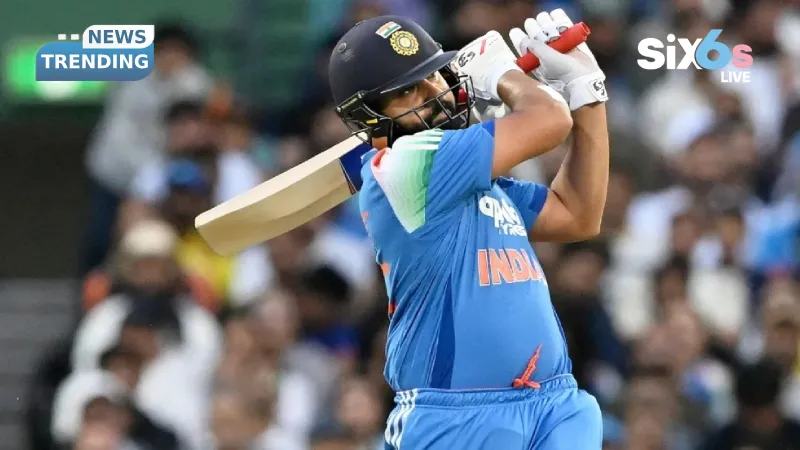
It seemed simple enough to assume that Rohit Sharma’s reign as one-day batting giant had quietly faded at age 38. After a half-decade that saw his game defined less by big scores and more by big responsibility, many felt that the old Rohit, the “rhythm man” who could turn watchfulness into a whirlwind, was no longer with us. But all of that changed in Sydney on a beautiful sunny afternoon when India needed to chase just 237 to win. Rohit’s 121 (not a loud statement but rather a gentle reminder) showed for the first time in five years that Rohit still had the wrists to hum out runs like he did during World Cups.
Rebuilding the Rhythm: The Series as a Mirror
The nostalgia was not a momentary fluke. Tempo evolved as the series itself slowly came back on track. In Perth, the aggressive Rohit had a fiery surface – seam, bounce, and failure. In Adelaide, he made adjustments, using two maiden overs off Hazlewood and a cautious reset, before being able to score fluently with a 73 (97) by the end of the day. By the third test at Sydney, the innings appeared almost predictable – it was a gradual increase of tempo, but a natural build-up to the climax, not a one-off. That there is an analytical appeal to the process of how Rohit transitioned from the different surfaces in each venue, as opposed to changing his tactics, to allow his timing to determine the amount of adjustment he needed to make to get back into rhythm, can be seen in the way the old ODI rhythm of bat – survive, settle, surge – was re-emerging.
The Forgotten Art of Building an ODI Innings
ODI cricket has become an impatient game. The emphasis placed on a player’s strike rate and the “intent” they show has made the 50-over long ODIs seem like something from the past. Rohit Sharma’s 100 against Australia served as a reminder of how much a player used to be able to build their innings (and therefore score) through methodical construction rather than explosive hitting. From 2013 until 2019, Rohit’s period of time where he dominated ODI cricket, he hit 25 centuries, averaging 61.4 per hundred. His approach was both obvious and unbreakable: slow start to innings, dominate the middle of the innings with little fanfare, and then finish strongly. He did not need to be aggressive as the target was low enough, but he built all of the other layers of that model in his innings against Australia: timing, patience, and cautious use of risk. That was not just a century; it was a lesson in controlled play.
A Captain Turned Craftsman Again
Much of Rohit’s statistical downfall in the past five years coincided with his captaincy. As India’s main risk-taker, he would explode in the top order, setting the tone while others like Gill, Kohli, and Iyer rebuilt. That altruistic gesture meant tons of runs were sacrificed, but India was aggressive. Now, without that constant tactical pressure, even for a short time, he is a man enjoying his work again. The flows of the bat were freer, the eyes bright, the decisions made were more clearly calculated. He was not after a narrative, just batting for the love of it. The statistics, an average of 47.65 and a strike rate of 111 plus since 2020, tell a tale of efficiency, not decline.
The Question of Longevity: Still Worth the Wait?
The whispers will not die away. Rohit Sharma will be 40 when the ODI World Cup of 2027 lands in South Africa. Will he keep his relevance in a format that India itself hardly plays anymore? But this is exactly why this hundred in Sydney is important. It is not Act Three; it is proof that he still reads the game better than anyone. Batting first on flat pitches will be the true examination, but on difficult surfaces, Rohit’s ability to adapt is still worth its weight in gold. A much more manageable schedule and reduced workload may be just what he needs to stay fresh. For the time being, the selectors have seen what they needed to see least to doubt whether Rohity’s game is intact, his hunger intact-er.
Rohit Sharma scored a century in Sydney, but what he did more than that is prove a philosophy for cricket – specifically ODIs, about how timing and patience are better than speed and panic. His performance did not need an “exclamation” mark – it was a whisper of endurance.
His post-match conversation with Gilchrist and Shastri was a reflection of a past time. He had at times destroyed Australia by making back-to-back hundreds – but today, he is quietly saying goodbye to familiar grounds. As long as his bat continues to sing with such tone, Rohit will continue to be relevant in ODI cricket – not as a captain or a tired veteran – but as one of the last truly creative minds in ODI cricket.
Key Takeaway:
Rohit Sharma hasn’t slowed down; he’s just redefined what pace means.
Stay updated on the latest cricket news and exciting updates at Six6slive. Dive into our in-depth articles and analyses to connect with the action today!